

Lessons From the New Orleans Funeral
By Calvin M. Amato
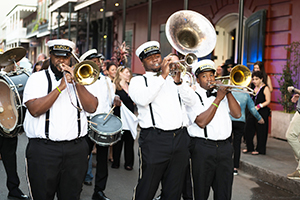
There are places in this world where death is not quiet, where “farewell” is not whispered but sung, where grief and celebration walk side by side, where the procession lifts the deceased instead of merely following them. New Orleans, Louisiana, is one such place. And for those of us who work in funeral service, it serves as a mirror and a challenge.
We funeral directors continue to debate how to remain relevant in an evolving world, but New Orleans has never had to ask this. Funeral service is relevant here because it is real. It does not dilute sorrow nor rush past it. It does not reduce the individual to a line in a eulogy or a bullet point in an obituary. Here, we remember the person and render that memory in ritual, music and movement.
This is not performance for performance’s sake. It is ceremony as biography. In an era where families are drawn to experiences that feel personal, meaningful and emotionally authentic, it is, perhaps, the clearest example we have of what funeral service can be when we stop managing loss and start honoring life.
Why the New Orleans Funeral?
There was a time when uniformity was the professional standard. Deviation from the traditional model was seen as distraction. That time is over. Families are asking for more. They are asking for depth, for personality, for something that feels like it could not belong to anyone else. And they are right to ask this.
We are not in the business of interment or cremation. We are in the business of meaning. We create spaces where grief can breathe, where memory can take root, where a life story can unfold in a way that is both sacred and true.
The New Orleans funeral – with its signature procession – exemplifies this. It reminds us that funerals are not passive events to be attended; they are participatory rites. The tradition of the Second Line is an act of collective remembrance and expression of loving reverence.
Beneath the music, the movement and the unmistakable energy of a New Orleans goodbye, there is something profound: a recognition that we must see the dead clearly in order to honor them. Their personality is the whole point. The particular, peculiar, wonderful details of their life are not indulgences but foundations.
Although this is a New Orleans “thing,” it is a professional lesson for all. The soul of funeral service lies in the preservation of meaning.
There is pressure in this profession to play it safe, to follow the formula. But safety rarely inspires, and it almost never comforts. What comforts is authenticity, what resonates is specificity, and what heals is ritual.
We have seen – again and again – that when we let personality guide the structure of a service, when we prioritize the emotional and symbolic needs of a family, we actually elevate our professionalism.
The funeral service profession is at a crossroads. On one path lies standardization – efficient, consistent and, ultimately, forgettable. On the other lies personalization, artistry, human connection. The latter path is more challenging, yes, but it is also where our calling lives.
New Orleans should be viewed as a blueprint. It is a testament to the idea that ritual can be sorrowful and celebratory. When we craft services with care, creativity and cultural fluency, we gain resonance.
Let them call it a “cult of personality.” If the implication is that we center our work around the unique identity, voice and impact of each life, then we should accept the title with pride. The funeral is not going anywhere because meaning is not going anywhere. Grief is not going anywhere. The need to say goodbye, beautifully and honestly, is as ancient as humanity itself.
We are not here to oversee farewells. We are here to help compose them with clarity, with care, with the full force of the life being remembered.
The world is changing. Families are changing. Expectations are changing. So, too, must we.
There is a reason New Orleans is the city to which the world turns when it wants to understand the reverence and radiance of death rituals. The architecture of the New Orleans funeral involves the choreography of grief and celebration – designed not to distract from sorrow but to hold it in tension with joy. It is, in every sense, a ritual that reflects the human soul.
New Orleans does not flinch in the face of death. It does not sanitize it. Instead, it offers something bolder: permission. Permission to weep, to laugh, to march, to sway, to remember, to gather, to dance.
The funeral is not going anywhere because meaning is not going anywhere. Grief is not going anywhere. The need to say goodbye, beautifully and honestly, is as ancient as humanity itself.
In a world of AI-generated obituaries and hastily arranged services, New Orleans stands defiantly as a place that refuses to forget how deeply personal the end of a life can be. The city’s funeral traditions, including traditional Catholic symbolism and the West African- and Creole-inspired jazz funeral, are grounded in centuries of spiritual fusion, cultural legacy and community ritual. The result is an experience that is less about closing a chapter and more about honoring the full arc of a life.
Perhaps no funeral in recent memory captures this spirit more vividly than the service of New Orleans socialite and philanthropist Mickey Easterling, held at Jacob Schoen and Son Funeral Home. It was akin to a final performance.
She sat, propped on a wrought-iron bench with her legs crossed, draped in feathered couture, overseeing her own celebration with characteristic flair. She had a cigarette in one hand and champagne in the other. Her posture was poised, and her personality was present. Although the image sparked headlines and controversy, it also sparked conversation.
The novel presentation asked the world to consider what it means to be remembered through presence. It was an unapologetic declaration that funerals should not be confined to quiet corners, especially if that’s not how the individual being remembered lived.
Easterling’s funeral was not the norm – nor should it be. But it was a reflection of her, and that is precisely the point. It was theatrical, yes, but it was also meaningful, intentional and deeply personal. And it was carried out with professionalism, precision and respect. The Jacob Schoen and Son staff did not sensationalize her farewell. They honored and facilitated it, and they understood that their role was not to edit out her personality but to make room for it.
This is what New Orleans gets right.
Families trust us because we know when to honor tradition and when to break it in service of something greater: authenticity.
After all, authenticity is what makes New Orleans funerals so unforgettable. The Second Line that cracks open solemnity and carries people down the street in communal rhythm. The jazz band that begins with sorrow and swells toward celebration. The neighbors who stop what they are doing, place their hands over their hearts and fall in step with the procession. They recognize the moment, and they understand its gravity. They know that it matters.
This is what funeral service is meant to do.
The New Orleans funeral is not going anywhere because it offers something timeless: meaning through ritual. It reminds us that remembrance must never become routine. Our work, when practiced with artistry and intention, is capable of delivering true catharsis.
Becoming Artisans of Remembrance
The New Orleans philosophy can and should be adopted everywhere. This mindset says that personality is sacred; that ceremony should reflect identity; and that families deserve an experience that reflects who their loved one was, how they lived and what they meant. This is the funeral profession at its highest calling. And New Orleans proves that when we do this well – when we do it bravely and beautifully – we do more than bury the dead.
We live in an era where the individual has become the centerpiece of every meaningful experience. Thanks to curated social media feeds and hyperpersonalized marketing, the world no longer revolves around genericness. It revolves around story, authenticity and essence. This cultural shift did not bypass deathcare.
The family members we serve are no longer satisfied with a funeral service that feels impersonal or indistinguishable. They want the service to feel like their person. To sound like them. To smell like their kitchen, echo their laugh and carry the fingerprints of their passions. This is human nature, and it is what defines excellence in modern funeral service.
The cult of personality is about understanding the gravity of every life and recognizing that our responsibility is to help translate that gravity into ceremony. It is about honoring both the fact that someone died and the way they lived.
Funeral directors, embalmers, celebrants and arrangers: We are not simply technicians and administrators. In today’s deathcare landscape, we are facilitators of memory and interpreters of meaning. We are entrusted with emotional legacy.
This evolution is happening right now – across every region, community and faith tradition. In rural towns and urban centers alike, families are requesting services that move beyond the traditional model. They want services that reflect tattoos and playlists, favorite meals and inside jokes, careers and eccentricities.
They want to feel their loved one’s presence, not only in the urn or the casket but also in the atmosphere. And when we meet that need with professionalism, reverence and creativity, something extraordinary happens: The funeral becomes transformative.
These services do not erase grief; they honor it. They give structure to pain. They give language to what is often unspeakable.
And New Orleans proves that when we do this well – when we do it bravely and beautifully – we do more
than bury the dead.
This movement is growing because it addresses something essential: the human longing to be known, even in death. We all share the desire to be remembered for our rhythm, our joy, our unmistakable presence.
Gone are the days when mastery was defined by formal elegance or procedural accuracy. Today, mastery entails cultural fluency, emotional intelligence, and the ability to listen to both what family members say and what they hesitate to say. We must strive to read between the lines of grief and uncover the details that will anchor a ceremony in truth.
The cult of personality in deathcare demands that we become artisans of remembrance. It asks us to hold equal reverence for tradition and innovation. We must develop the same level of proficiency in symbolism, storytelling and creative expression that we have in embalming and compliance.
A funeral with personality is a collaboration. When done well, it feels like a sacred expression. Our role is to bring that expression into form with dignity, care and clarity.
We already are seeing remarkable examples of this in every corner of the profession:
- A motorcycle hearse flanked by riders in leather jackets, because the deceased lived for the open road
- A memorial service in a library filled with books the decedent once loved
- A green burial where guests write messages on biodegradable seed paper, then return both grief and life back to the earth
These moments, when facilitated with intention, become something of a balm, a mirror. They’re a testament to the fact that love endures through storytelling and that memory has its own architecture – one that funeral professionals are uniquely positioned to build.
This is the cult of personality – not a threat to the industry but its greatest opportunity.
Families are not asking us to be entertainers. They want us to be attuned, to be bold in our creativity, to be humble in our service, to be fearless in our belief that funerals still matter – because they do.
In an age where people often are reduced to data, hashtags or headlines, the funeral remains one of the last opportunities to witness a life fully. It is our job to ensure that witness is as honest, as powerful and as personalized as the life it seeks to honor.
The future of deathcare belongs to those who recognize this as the new measure of excellence. This begins by seeing each life as a story to tell.
The future of funeral service has already arrived. The expectations have shifted. The questions have changed. The vocabulary of grief has evolved. What might have sufficed as “standard” at one point now feels sterile. What once passed for meaningful now reads as mechanical.
The funeral of tomorrow is not a distant possibility; it is today’s unmet need.
It is no longer enough to deliver what is expected. We must deliver what is imagined. That is the role of the modern funeral professional: to serve as the conduit between memory and meaning, and to do so with courage and care.
This does not mean abandoning tradition. It’s quite the opposite. It means understanding tradition deeply enough to know when to build upon it.
To meet this evolving need, we must expand our definition of service. We must think like designers, communicate like educators and lead like visionaries. It is no longer sufficient to ask, “Did the service run smoothly?” The better question is: “Did the service speak the truth?”
Family members are not just seeking closure; they are seeking resonance. The greatest gift we can offer them is a funeral experience that feels like their loved one because it reflects their values, their quirks, their contradictions and their legacy.
To achieve this, we must be willing to evolve deliberately. This means deepening our listening skills. It means paying attention to subtle cues, to body language, to passing comments that hint at who the deceased really was. These are the details that give rise to a meaningful service. They are also the details that cannot be automated or prepackaged.
Our work is and always has been human.
And as we lean into this truth, we must equip ourselves accordingly.
We must invest in training that extends beyond regulatory compliance and into the art of ceremony. We must learn how to guide families through the process of storytelling – how to ask the right questions; how to gently pull the threads that lead to a fuller picture; how to translate personality into form, whether that form is an urn engraving, a eulogy or the structure of the funeral itself.
This is not extra work. This is the work. At its highest expression, our profession is about transformation. It is about helping people move from disbelief to understanding. That transition, when facilitated with skill and empathy, is sacred. And it is entirely incompatible with mediocrity.
We also must recognize that the funeral of tomorrow will demand interdisciplinary wisdom. It will ask us to understand cultural nuance, spiritual diversity, digital technology and social evolution. It will ask us to be responsive rather than reactive. And, perhaps most of all, it will ask us to be brave.
Transformation is never convenient. It disrupts, it challenges, and it requires vulnerability. And in a profession built on tradition, there is an understandable resistance to change. It is precisely this resistance that we must learn to face gently, boldly and with integrity.
The next generation of funeral professionals is already rising to the challenge. They are bringing fresh eyes, energy and a level of commitment to emotional authenticity that has the power to renew the soul of our work. But they cannot do it alone, nor should they.
What this profession needs is collaboration. It needs mentorship that honors legacy without clinging to it. It needs leadership that is humble enough to listen but bold enough to act. It needs funeral homes that are willing to invest in more than infrastructure. They must be willing to invest in people, purpose and possibility.
The funeral of tomorrow is built one conversation at a time, one family at a time, one courageous decision at a time.
We must stop asking if the future will change the funeral profession. It already has. The real matter is whether we are willing to meet it with the creativity, reverence and individuality we claim to celebrate.
If we are, we will not only preserve but also elevate the heart of funeral service. We will become both caretakers of the past and co-creators of the future.
And when the future asks who helped shape it, may it be able to point to us, not as relics of tradition but as facilitators of transformation.
What we carry matters – and I’m not talking about the casket or the urn. I mean the weight of meaning; the burden of memory; and the sacred responsibility of saying, “This life mattered,” and then proving it through ritual, story and presence.
This is our work. And it is holy. We are caretakers of remains, yes, but also of identity, of complexity, of the countless contradictions that make a human being unforgettable. And in this role, we become something extraordinary. We become the shepherds of how the world remembers.
New Orleans has always understood this because its funerals are not mere services. They are offerings. They are processions forward, upward, outward, into something more than grief. They carry the fullness of life through streets that have known joy and sorrow for centuries, and they remind us that memory is fierce.
That model might wear different clothes in different cities, but the soul of it – the principle that ceremony must reflect the individual – is universal. It is not a trend. It is not a novelty. It is the very heartbeat of why we gather.
The cult of personality in funeral service is not a threat but a reckoning. It demands that we move beyond the safety of sameness, and it challenges us to trade convenience for creativity, repetition for resonance, and formality for something far more formidable: truth.
This moment is an awakening. It is the realization that what we do will only endure if it is rooted in relevance. The funeral home of the future will be built by listening deeply to the hearts of those we serve and then responding with soul.
We are being asked to reinterpret tradition, to translate it, to breathe life into it, again and again, for every family, every time. This is not easy work, but it is the right work, and it is ours.
So, let us walk forward, not with fear but with clarity. Let us raise the standard, not lower our gaze. Let us offer what is most meaningful – always. And let us remember: In a world that often forgets, we are the ones entrusted with memory.
The music will change. The faces will change. The language of grief will change. But the need for ceremony and the need to gather, to remember, to mark the mystery of a life lived will not.
The funeral of tomorrow is waiting to be built. Let us compose it, craft it and carry it together. Like a Second Line swelling in the streets. Like a gospel that refuses to die. Like a promise that says: “You were here. You mattered. And you will not be forgotten.”
Calvin M. Amato is a licensed funeral director. He is also a national consultant and brain-recovery specialist working in collaboration with academic research institutions including Harvard and Boston University. He serves as vice president of the Center for Death Education and sits on the boards of several grief-focused organizations. An internationally published author, Amato is committed to pushing the boundaries of modern deathcare and advocates for forward-thinking solutions that meet the demands of 21st-century funeral service.